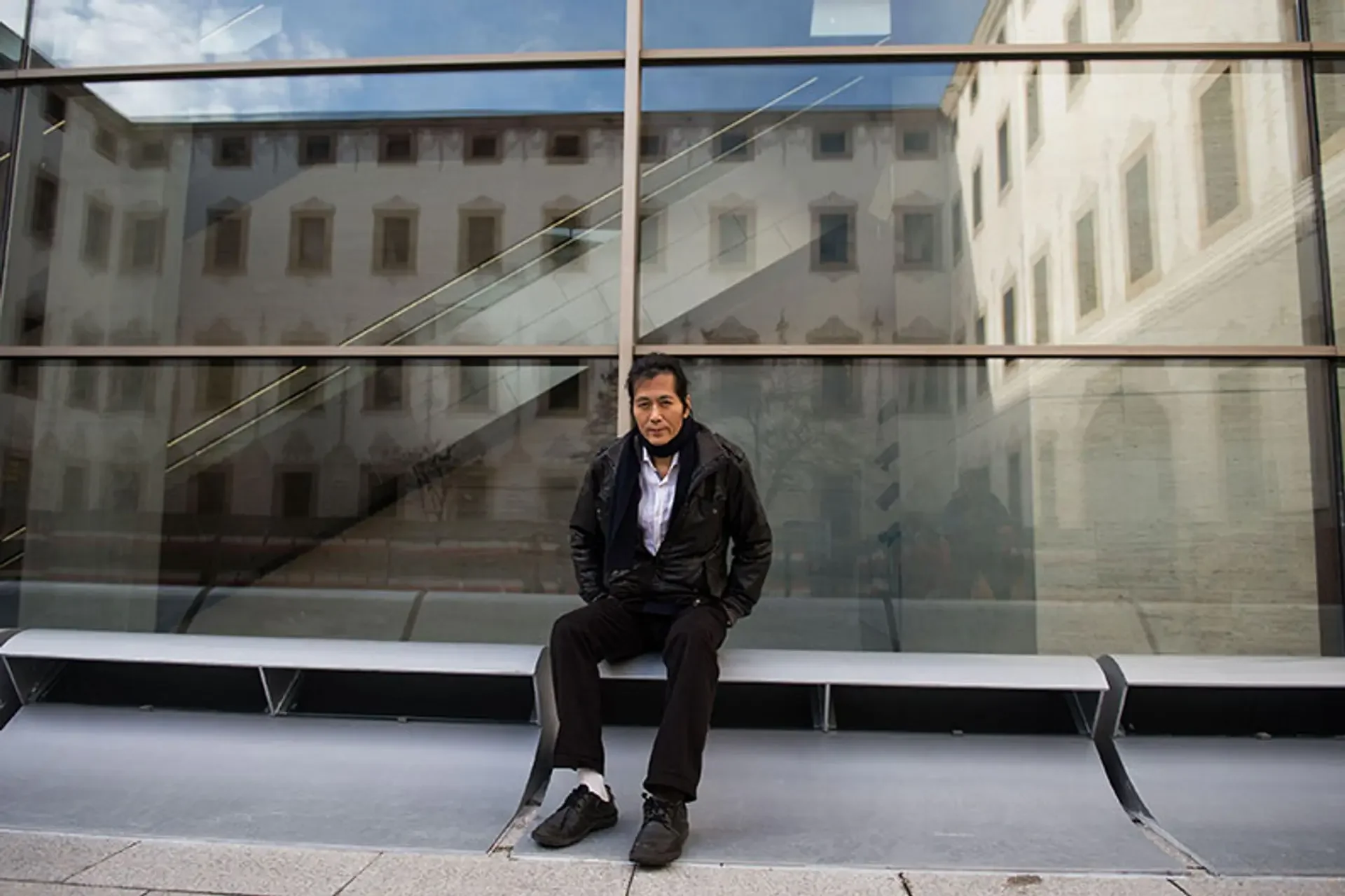
Korean-German philosopher and author Byung-Chul Han–himself a dear friend of the performing arts–tries to tackle issues like narrative, ritual, attention, and other humane topics. Han spent his teaching years at Universität der Künste Berlin (Berlin University of the Arts) and frequently relies on not only Heidegger, Nietszche, and Arendt, but also converses with any number of composers, filmmakers and literati. (Tellingly, one published German language book set for 2026 release in English translation is titled The Tonality of Thought.)
Han approaches narrative at the broad level of culture and the wide span of seasons, years, and decades. Classical music is well-known for its embrace of long time scales. But with few exceptions, no music tries to provide meaning at that scale.
For Han, there is a distinction to draw between narrative and storytelling. It’s an interesting cut!
Here’s what Han has to say (in this particular paragraph, he uses phrases like “micro-narratives” though throughout the preface, he more often calls them “stories.”) :
A world-changing and world-opening narrative cannot be created by the whim of a single person. Rather, it owes its existence to a complex process in which various forces and actors are involved. Ultimately, a narrative is an expression of the mood of a time. Such narratives, which have an inner moment of truth, are the opposite of the eviscerated, exchangeable and contingent narratives – that is, the micro-narratives – of the present, which lack gravity, which lack any moment of truth.
–The Crisis of Narration, viii-ix
The implications found in Han’s highly readable and relatable work are vast, so I will stay unconscionably narrow:
Putting aside the question of “narrative” in the way I have used it - to derive and drive meaning in individual compositions, Han does bring out some other important ways of looking at events like a performance or even a rehearsal: as a ritual around organizing meaning. See Han again:
Religion is a typical narrative with an inner moment of truth. It narrates contingency away. Christian religion is a meta-narrative that reaches into every nook and cranny of life and anchors it in being. Time itself becomes freighted with narrative. In the Christian calendar, each day is meaningful. In the post-narrative era, the calendar is de-narrativized; it becomes a meaningless schedule of appointments. Religious holidays are highlights and high points of a narrative. Without a narrative, there are no festivities, no festive times – no festive moods with their intensified feeling of being. All that is left are work and free time, production and consumption. In the post-narrative era, festivities are commercialized. They become events and spectacles. Rituals are also narrative practices: they are always embedded in a narrative context. As symbolic techniques for creating enclosure, they transform being-in-the-world into a being-at-home.
–Crisis of Narration, viii
I won’t sugarcoat my view: The past two decades have seen Robert Putnam, Neil Postman, and DFW’s darkest visions not only come only to be surpassed in creating comprehensive isolation for millions.
We suffer a “Crisis of Narration” because Han’s conception of narration drives meaning.
And that’s where we come in.